
Reviewed · MAUI WHALE WATCHING TOURS
Whale Watching Maui: 2-Hour Small Group Raft Tour from Lahaina
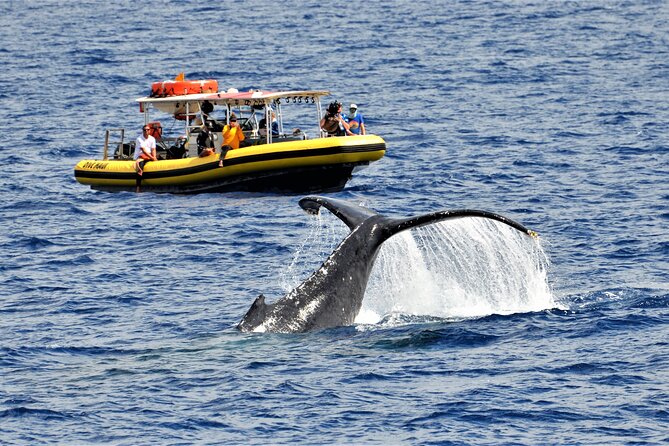
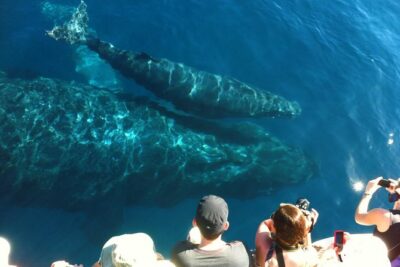
Maui’s humpback season turns a short boat ride from Lahaina into a search for mothers, calves, escorts, and breaching young whales. This two-hour raft trip keeps you close to the water, with open views in every direction and a hydrophone that lets you hear whale songs beneath the boat.
I like the small-group format, which can make it easier to see over the side and ask questions. I also like the crew’s teaching style, especially guides such as Renee and Brian, who explain whale behavior rather than simply point at a spout. The tradeoff is that wild whales set the schedule, and the raft can feel rough or wet in poor conditions.
Key points to know before booking
- Whale songs are part of the trip: A hydrophone and speakers let you listen to humpback calls below the surface.
- The raft holds no more than 20 people: Some departures have had only eight passengers, leaving plenty of room to look around.
- Maui Nui is prime winter habitat: Humpbacks come here to mate and give birth during the seasonal migration.
- Your whale sighting is guaranteed: If conditions allow the trip to run and no whales are seen, you can take another trip free.
- The crew makes the difference: Captains Will and Joe, along with naturalists Renee and Brian, receive repeated praise for clear explanations and active searching.
- The $80.60 price buys intimacy, not legal closeness: Small boats may maneuver well, but all operators must follow whale-protection rules.
Leaving Lahaina for Maui Nui’s humpback waters
You meet at Dive Maui and Hawaiian Rafting Adventures, at 1223 Front Street in Lahaina. The activity ends at the same place, so you do not need to arrange a separate return ride or wonder where the boat leaves you.
The outing lasts about two hours. That is long enough to get into the whale area, spend meaningful time watching, and return without giving up most of your day. If you are planning a full schedule of beaches, meals, or another boat trip, this shorter format fits more easily than a half-day cruise.
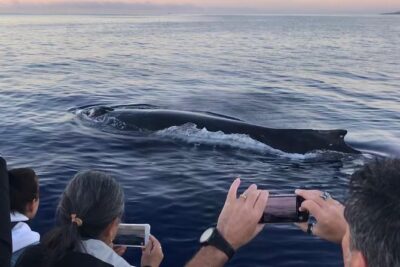
The setting matters. During the winter migration, humpback whales gather in the warm waters around Maui to mate and give birth. The Maui Nui whale sanctuary is not a zoo or a show venue. You go out, scan the horizon, and wait for the signs of life: a blow, a tail, a rolling back, or a sudden breach.
That waiting is part of the experience. Some trips bring repeated action from several whales. Others may be quieter. The company guarantees a whale sighting or a free return trip, but it cannot make a whale breach on command or control how active the animals will be.
More Lahaina tours and cruises:
- Maui Eco-Raft Tour: Eye-Level Whale or Dolphin Watching – Lahaina
★ 5.0 · 2,482 reviews - Maui: Lahaina ATV Adventure
★ 5.0 · 1,582 reviews - Maui: Ultimate Whale Watch from Lahaina
★ 5.0 · 1,162 reviews
Why the inflatable raft changes the view
The custom-built inflatable raft gives you a low position on the water and 360-degree sightlines. You are not looking through cabin windows or trying to see over several rows of seats. Every passenger has a reasonable chance to scan the horizon, and the compact boat can move toward promising activity without the size of a large vessel getting in the way.
That does not mean the raft can legally approach whales more closely. Hawaiian whale-watching rules apply to vessels of every size, and the whales determine how near the boat may be. A small boat can sometimes position itself efficiently, but you should not book this expecting guaranteed nose-to-nose encounters.
The low ride has a second side. It can feel more lively on the ocean, particularly when wind and waves pick up. You are closer to spray, too. Rain ponchos are provided on rainy days, but dress for a boat rather than a stroll along Front Street. Keep cameras and phones secure, and remember that the most exciting whale may appear behind you.
The boat can hold up to 20 people, though some departures have carried only eight. That difference matters. A nearly full raft will still be smaller than many commercial boats, but a lightly booked trip gives you more elbow room and makes it easier to shift your attention from one side to another.
Finding mothers, calves, and escort whales
The crew’s main job is to read the water and find active whales. Reports from this operation describe sightings of mothers with calves, escort males, competing males, and young whales practicing breaches. One particularly active outing included a mother and calf, several males, and baby whales making repeated jumps.
This is the sort of behavior that gives the trip meaning. A mother and calf may stay together near the surface. An escort male may compete for access to a female. A young whale may slap its tail or attempt a breach while learning how to control its large body. You may see only a few seconds of each event, so the crew’s ability to move your attention quickly is useful.
Captains such as Will and Joe are often singled out for finding active groups and positioning the raft without getting in the whales’ way. Naturalists including Renee and Brian add the background: what the escorts are doing, why calves remain near their mothers, and how to interpret the blows and surface movements.
The descriptions are enthusiastic, but keep your expectations sensible. One passenger reported a subdued outing and felt the small raft did not offer enough extra value over a cheaper large boat. That is a fair warning. The smaller vessel improves the viewing setup, but it does not guarantee more whales, closer whales, or dramatic behavior on every departure.
Hearing the whales through the hydrophone
The hydrophone is one of the strongest reasons to choose this trip over a basic sightseeing ride. The crew lowers it into the water and sends the sound through onboard speakers, allowing you to hear the humpbacks while you are surrounded by open ocean.
You may see a whale surface and then hear its song below. That combination changes the mood of the trip. Instead of only watching for movement above the water, you gain another way to understand that whales are present even when they disappear from sight.
The sound feature also gives the naturalist something useful to explain. You can ask about whale communication and behavior while the boat is paused near an active area. The guides are not there only to identify species. They share information about the sanctuary, the seasonal migration, mothers and calves, and the role of escort males.
If the whales remain below the surface, the hydrophone may be especially valuable. It cannot replace a breach or a close passing whale, but it adds substance during the quiet stretches. For families and first-time whale watchers, that extra layer can keep the outing from becoming a simple contest to spot a spout.
More Maui whale watching trips:
- From Maalaea: Whale Watching Tour Aboard the Quicksilver
★ 4.5 · 1,461 reviews - WHALES GUARANTEED Maui Whale Watching Makai Adventures
★ 5.0 · 1,081 reviews - Ma’alaea Harbor: Whale Watching Tour Aboard Power Catamaran
★ 4.6 · 979 reviews - Maui: Whale Watching Cruise with Open Bar from Ka’anapali Beach
★ 5.0 · 802 reviews
The crew and the value of a small group
The strongest feature here is the human side of the trip. Captain Will and naturalist Renee are praised for pairing active searching with lively explanations. Captain Joe and naturalists Brian and Renee also receive repeated approval for answering questions, sharing facts, and keeping the mood friendly.
That matters more on a two-hour trip than it might on a long cruise. There is not much spare time, so you want the crew to explain what is happening as it happens. A good naturalist can turn a distant back into a lesson about whale behavior. A good captain can help the group face the right direction before the moment passes.
I would particularly favor this outing if you like asking questions. The small setting makes conversation easier than it is on a large boat with a distant public-address system. You may also appreciate the crew’s clear respect for the animals. The goal is to position the boat well, not force an encounter.
The maximum group size is 20, and the company describes the experience as family-friendly. Children under three are not permitted, and pregnant people may not participate. Service animals are allowed, and most people can take part, but the raft format is best for anyone comfortable with an open-water ride and changing conditions.
Price, inclusions, and what you are really paying for
At $80.60 per person, this is not the cheapest way to watch whales from Lahaina. Large boats may cost $30 to $40 less, according to one dissatisfied passenger. If your only goal is to spend time on the water and perhaps see a blow in the distance, the larger vessel could be enough.
The extra cost makes more sense if you value a lower boat, open sightlines, a smaller crowd, and direct access to a naturalist. You also receive filtered water in paper cups, reef-safe sunscreen, and rain ponchos when the weather calls for them. The bottled-water description is best understood as included drinking water, supplied with an effort to reduce plastic waste.
Alcohol is not included, but you may bring your own. Glass containers are not allowed. I would keep this simple. A two-hour whale trip is better suited to water and a secure camera than to carrying drinks that can spill on a moving raft.
Booking about 26 days ahead is common, so advance planning is sensible during the busy winter whale season. If your dates are flexible, you may have a better chance of finding a smaller departure or moving around poor weather.
Weather, cancellations, and the whale guarantee
This is a weather-dependent activity. High winds and rough seas can cancel a departure, and the operator has rescheduled trips when conditions were unsafe. That is frustrating when whale watching is one of the main events of your Maui visit, but safety should take priority over keeping to the original time.
If the company cancels because of poor weather, you can choose a different date or receive a full refund. If you cancel, you must do so at least 24 hours before the start time for a full refund. Cancellations or changes inside that window are not refunded.
The whale guarantee is useful, but read it correctly. If no whales are seen, you can take another trip free. It does not promise a certain number of whales, a breach, a mother and calf, or a whale swimming beneath the raft. Nature still controls the show.
For that reason, I would schedule this early in your Maui stay if whale watching matters a lot to you. A weather cancellation then leaves room to reschedule. Booking it on your last available morning gives you less protection, even with the guarantee.
Who will enjoy this Lahaina raft tour most
This trip suits you if you want a focused wildlife outing rather than a long cruise with many extra features. It is a good choice for couples, families with children three and older, and friends who prefer a smaller setting. It also works well for repeat Maui visitors who want to hear the whales and learn more about their behavior.
Photographers may like the open views, though the raft’s movement and the unpredictable animals make sharp photographs a matter of timing. Bring a camera, but do not spend the whole trip looking through it. The best moment may happen on the opposite side of the boat.
I would hesitate if you are very sensitive to motion, need a large stable deck, or expect the smaller boat to guarantee a closer view than the law allows. I would also compare prices carefully if you do not care about group size or the hydrophone.
The activity is recommended by 98 percent of participants and has a 4.9 rating from 661 reviews, which matches the broad pattern of strong praise for the crew, education, and whale sightings. Still, one low-rated experience points to a real issue: a small boat cannot manufacture wildlife activity. Your value depends partly on the day you go.
Should you book this whale tour?
Book it if you want two concentrated hours with a small group, a low raft, strong crew interaction, and the unusual chance to hear humpback songs underwater. The captains and naturalists appear to be the main asset, and the repeated reports of mothers, calves, escorts, and active young whales make this a tempting choice at $80.60.
Choose a larger boat if saving $30 to $40 matters more than the intimate format, or if you prefer a steadier ride. For the best chance of recovering from bad weather, reserve early in your Maui stay and leave your schedule flexible.
FAQ
Where does the whale-watching tour begin and end?
It begins and ends at Dive Maui and Hawaiian Rafting Adventures, 1223 Front Street, Lahaina, Hawaii 96761.
How long is the whale-watching trip?
The excursion lasts approximately two hours.
How many people can join the raft?
The activity has a maximum capacity of 20 people. Some departures may be smaller.
Is whale watching guaranteed?
Yes. If you do not see whales, you can take another trip for free. The guarantee does not promise specific whale behavior or a particular number of sightings.
What happens if bad weather cancels the tour?
You will be offered another date or a full refund if the activity is canceled because of poor weather.
Are young children and pregnant people allowed?
Children under three are not permitted, and pregnant people may not participate. Service animals are allowed, and most other participants can join.
More 2-Hour Experiences in Maui
- Maui: Two Hour Beginner Group Surf Lesson in Kihei
★ 5.0 · 950 reviews - Maui: 2-Hour Molokini Snorkel Trip
★ 5.0 · 816 reviews - 2 Hour Beginner Group Surf Lessons
★ 5.0 · 154 reviews - 2 Hour Private Group Surf Lesson in Lahaina Maui
★ 5.0 · 129 reviews
Just added around Maui
- Whale Watch Sail Ma’alaea★ 4.9 · 27 reviews
- Wailea-Makina: Sea Caves, Molokini Snorkel & Turtle Town★ 4.9 · 37 reviews
- West Maui and Molokai Special 45-Minute Helicopter Tour★ 5.0 · 9 reviews
- 2.5 Hour Whale Escape Tour★ 5.0 · 44 reviews
- Turtle Town Clear Kayak & Snorkel Tour (8am-11am)★ 5.0 · 6 reviews
- Maui: Private All-Inclusive Road to Hana Tour with Pickup★ 5.0 · 28 reviews
- Whalewatch Deluxe Tour from Ma’alaea Harbor★ 4.5 · 37 reviews
- Zumba Classes in Kihei Maui – Private or Group (This class is high impact )★ 4.5 · 6 reviews
Maui Whale Watching Tours, compared.
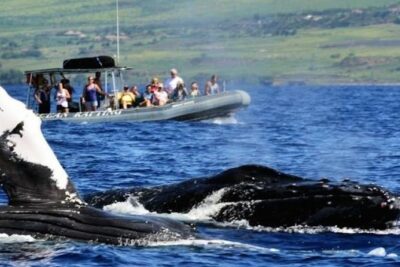
Maui Eco-Raft Tour: Eye-Level Whale or Dolphin Watching – Lahaina
Read our review →
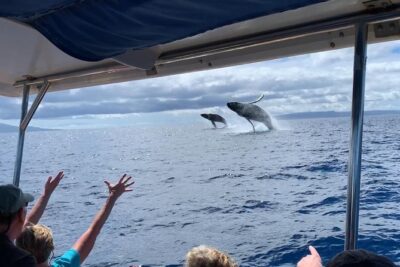
WHALES GUARANTEED Maui Whale Watching Makai Adventures
Read our review →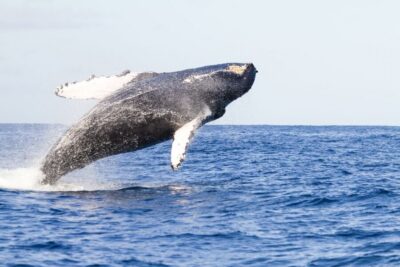
Ma’alaea Harbor: Whale Watching Tour Aboard Power Catamaran
Read our review →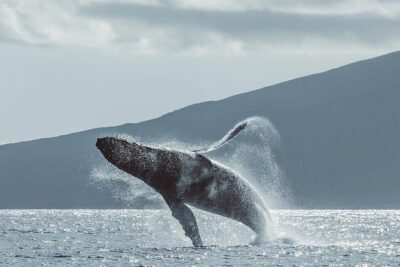
Whale Watching Cruise with Open Bar from Ka’anapali Beach
Read our review →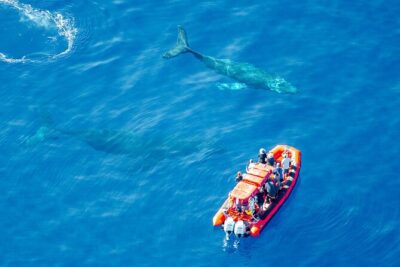
Browse the lists this tour appears in